A reflection on the lectionary readings for the eighteenth Sunday after Pentecost.
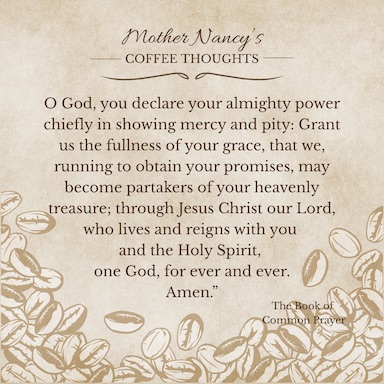
This is one of those Sundays where I’d like to talk about the Collect (the prayer assigned to the day with the readings, and that I put in the graphic for my Sunday posts) rather than the scripture. Mainly I just want to talk about how uncomfortable the word ‘pity’ in that prayer makes me. Does it bother you? Pity seems to invoke the idea of some outdated classist hierarchy in me. Does God really ‘pity’ us as we use the word in our 21st century western world vocabulary? I don’t think so.
It comes from the same Latin word that gives us piety. In fact when it entered the English language the two words pity and piety were interchangeable and both meant religious devotion and a charitable outlook. To have pity on someone was tied directly to the Christian life, to treat others as we want to be treated and to love God and our neighbour as ourselves. Through time and the evolution of our language however, the word ‘pity’ took on an unequal power dynamic of “I’m better than you because I have more/don’t suffer as much/not helpless…”. It became mucked up with moral judgement and condescension and devolved into how we tend to understand and use it today.
So, yes, God does show how powerful God is through showing mercy and, let’s swap out pity with compassion to better use our current language to describe the true nature of God. And these are characteristics that we don’t often equate with power today. In the same culture in which we equate pity with shame, power has become that which enables us to dominate and oppress others with physical strength or military might or emotionally and spiritually manipulative languages and behaviours. But it is only through God’s grace and mercy and compassion and love that we may know the life we are made for. And we can’t live this life when we place ourselves over and above anyone for any reason.
We are all God’s beloved and God does not love anyone more or less than another. And we are not to see others as more or less than ourselves because God doesn’t. Yes, we are all uniquely made with our own way of experiencing this amazing world and our own abilities to contribute to the redemptive work we are made to do but we are also to see ourselves as bound to each other as beloved children of God. Paul, in the reading from his letter to the church in Philippi tells us to “be of the same mind, having the same love.” It is God’s Love that enables us to live the life God made us for.
Just as parents receive great pleasure when our children find their place in this world and flourish not because it justifies who we are as parents but because they have discovered and are living the life they are made for, God rejoices when we choose to live by Love. This is God’s will for all of us and God enables us to live by God’s will because this is the life God made us for. God gave us the free will and reasoning abilities to choose for ourselves and when we choose to live life by God’s Way it does bring God great pleasure to see us flourish.
Jesus tells a story of two sons and a father’s request of them in response to the question from the temple leaders about his authority. It’s clear that the son who said no and then changed his mind are those who are outside of the Temple’s approval and the son whose words and behaviours are not congruent are those who claim to be God’s people yet do not live as God leads them. But before we start to think too much of ourselves let’s bring this lesson into our century and culture and link it to the reason I want to change the word ‘pity’ in the Collect for today.
Where we go to church, what denomination we belong to, the religious symbols we have in our house or on our car, the number of Bibles we own, how many charities we volunteer with, how many Bible verses we can quote, how much money we donate to church or charitable causes, none of this means anything if we see and treat those who don’t go to our church or do what we do to prove our faith as less than us, if we pity them rather than see them as fellow Beloveds who need a loving and compassionate reminder they they are God’s beloved, too. When we put ourselves above anyone else for any reason, we too need a reminder that we are fellow Beloveds.
Our life in our time and our culture is to be an invitation to others and as we follow Jesus we signpost others to his love and mercy and grace and compassion. The Temple leaders claimed God’s love for themselves and behaved towards others as if they were unlovable. They proclaimed God’s power with their words but did not live their lives according to the true nature of God’s power. This story of the two sons is Jesus’ way of asking us to be aware of when we do the same. When do we say yes to God and then don’t treat others as we want to be treated?
Like the temple leaders do we, with our behaviours and actions question Jesus’ authority even if we proclaim it with our words? Do we believe what he as shown us in flesh and blood is true power? The wisdom of knowing that mercy and compassion are powerful tools to build up God’s Kingdom-on-earth-as-in-heaven is the treasure we are created and called to partake in. When we attempt use them as weapons to elevate ourselves and exclude others we’ve lost the Jesus plot.
The good news in this story is that whenever we choose to say yes to working the vineyard of God’s Kingdom God welcomes us even if we’ve said ‘no’ either by words or behaviours before. It is God’s greatest desire that each us turn to God and live the life we are made to live. Amen.

Keep Lovin’ louder than the hate, Y’all!

