A sermon preached at Grace Episcopal Church, Cuero, Texas.
The readings for the ninth Sunday after Pentecost are here.
In our gospel reading today, we continue in the 13th chapter of Matthew’s telling of the Good News story. For the past few Sundays we’ve been looking at Jesus’ description in parable form of Kingdom-on-earth-as-in-heaven life. Two Sundays ago we looked at the story of the extravagant sower who scattered the good news of God’s love and Jesus tells us that just because someone may not receive God’s love doesn’t mean we aren’t supposed to share it abundantly and that it’s our responsibility to tend to our own soil so that we receive it in such a way that it bears more seeds to be scattered. And last week Jesus tells us that it is’t our job to determine the wheat from the weeds but to bear the fruit of God’s Kingdom.
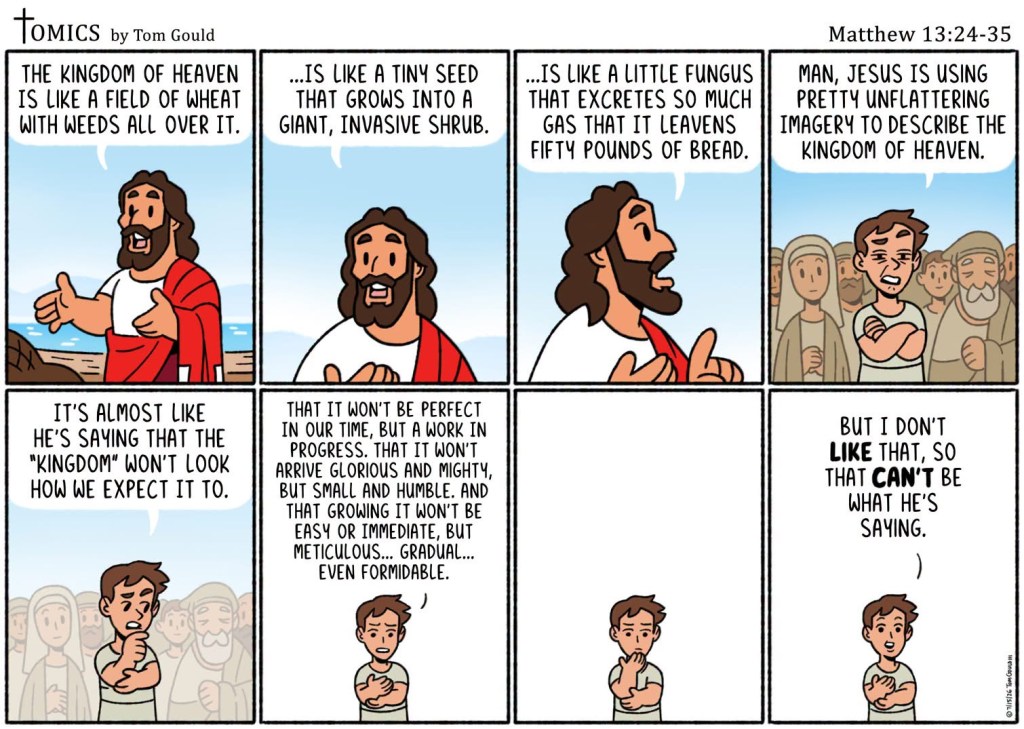
And today, we get this list of one line parables that paint a picture of God’s Kingdom-on-earth-as-in-heaven that perhaps isn’t always what we want or expect it to look like. The Kingdom of Heaven is like a mustard seed, yeast, hidden treasure, fine pearls, and a diverse catch of fish. Before we can see what each of these might mean, we first need to understand what Jesus means when he says ‘Kingdom of Heaven’. The word we translate into English as heaven literally means ‘the sky’. Those who heard Jesus speak these parables would not have thought of some far off place where we go when we die but that heaven is being under the protection of God’s glory in this world as God’s people.
Jesus’ talk of God’s Kingdom or the Kingdom of Heaven was subversive, meant to redefine what is to be expected from a Kingdom. In first century, Roman occupied Palestine, kingdoms sought power through violence, by pitting one group of people against another, and creating the kind of destructive competition that comes with a culture that labels some people as better than others or more valuable than others, defining who’s in and who’s out, who’s good and who’s bad. And Jesus comes along and says God’s Kingdom is different. God’s Kingdom welcomes everyone in and God sees everyone as beloved and infinitely valuable because God knows that all people are created in God’s image. We often need to be reminded of that by coming together in worship and praise of our Creator God, in prayer and repentance to receive the gift of God’s love for all people.
It’s no coincidence that when Jesus’ followers asked him to teach them how to pray, he taught us to pray for God’s will to be done on earth as in heaven. Jesus often says that the Kingdom of God is ‘at hand’ meaning it’s right here waiting for us to see it and take our place in it now. God’s Kingdom isn’t just about some day in the future but for us to be a part of now in this time.
This Kingdom may not be what we think it should be but that doesn’t make it any less real. A tiny seed doesn’t grow into a tree over night but takes years to be what it is intended to be. Yeast and flour can’t do much by themselves but when they are combined and used for their intended purpose, together they sustain the lives of many. The joy and treasure of God’s Kingdom – lives grounded in love, belonging, compassion, mercy, justice – are more valuable than anything in this world and the more we offer them to others the more there is. This world is made up of many different people, all sorts of fish to use Jesus’ metaphor, and our purpose is to grow along side all of them without deciding for ourselves who’s in and who’s out.
The stories and words that Jesus uses to tell us about the Kingdom-on-earth-as-in-heaven are grounded in the reality of the world. The illustrations he uses may not be common in our day and culture but the behaviors and attitudes and actions that Jesus is telling us to focus on are timeless and cross cultural: feeding our families, doing our jobs, nurturing our relationships, managing our finances. These stories call us to pay attention because we never know when we might encounter the unexpected treasure of God’s Love. With our whole life , we are to share the good news of God’s Love for all people abundantly. Jesus didn’t come to give us an escape route from this world but to show us in flesh and blood how to live in God’s Kingdom in every time and every culture.
To use Paul’s words, God has already decided that all people, everyone whom God has created, are to be part of God’s Kingdom. God has known each of us and every human who ever was, is and will be since the beginning of creation. It is God who justifies us, not our own actions. It is through the life, death, and resurrection of Jesus that we are adopted into God’s family. The actions and behaviors that are the fruit of our faith in God – feeding the hungry, sharing our abundance, caring for others especially those our culture tries to shove aside, tending to creation, working to dismantle the unjust systems of this world, are our response to God’s Love and will for all of us, to live as we are made to live as if God’s Kingdom were already fulfilled in the New Earth and New Heaven.
There is nothing that can separate us from God’s Love, it is right here with us always in all that we think, say, and do. Sometimes we just can’t see it or aren’t aware of it. And so we are reminded by the stories Jesus tells and the stories of Jesus that our Gospel writers have given us that God’s Kingdom doesn’t look like the kingdoms of this world but it is very, very real and present, full of the true treasures of life, love, compassion, mercy, and justice. And there’s more than enough for everyone.
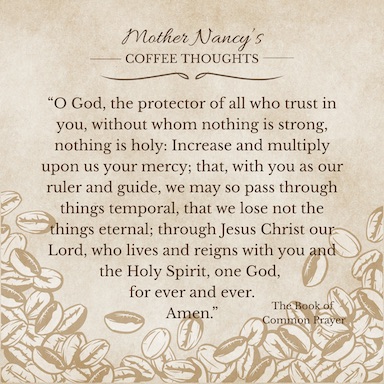
As we wrap this up, I’d like to return to the prayer we prayed at the beginning of the service. “O God, the protector of all who trust in you, without whom nothing is strong, nothing is holy: Increase and multiply upon us your mercy; that, with you as our ruler and guide, we may so pass through things temporal, that we lose not the things eternal; through Jesus Christ our Lord, who lives and reigns with you and the Holy Spirit, one God, for ever and ever.”
What is it that we ask God for? Not more power or more might but for God to multiply in us God’s mercy so that we keep our eyes on God’s Kingdom-on-earth-as-in-heaven as we live in the rhythm of time (the meaning of temporal) that God has provided us. When we hear the word ‘eternal’ our minds tend to go forward into the distant future but we have to remember that eternity has no beginning as well as no end. God’s kingdom, God’s way of life for us, has always been and always will be. We just have to open our hearts and minds to let Holy Spirit give us the eyes to see and ears to hear it all around us, right here at hand. Amen.