A sermon preached at St. Martin’s, Mason, Texas.
The lectionary readings for the sixth Sunday after Pentecost are here.
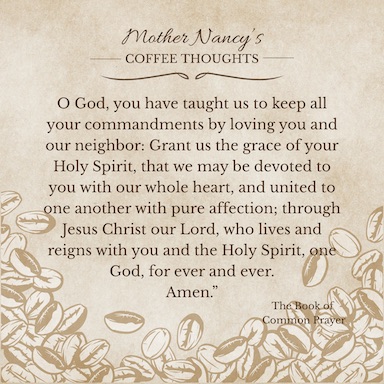
To get us started today, I’d like to revisit the prayer we prayed at the beginning of our service: “O God, you have taught us to keep all your commandments by loving you and our neighbor: Grant us the grace of your Holy Spirit, that we may be devoted to you with our whole heart, and united to one another with pure affection; through Jesus Christ our Lord, who lives and reigns with you and the Holy Spirit, one God, for ever and ever. Amen.
And now I’ll offer a bit of a confession – I always struggle to preach on or around July 4. I feel caught between honoring the birth of our country and proclaiming God’s Good News for all people, especially now when so much of what the leadership of our country is doing is bringing intentional harm to others in order to elevate a select few, actions that are antithetical to God’s Good News. I can celebrate the ideals of this country – life, liberty, the pursuit of happiness, and justice for all people even if these seem hard to come by right now. I can pray that we may be devoted to God and united to one another with the hope that we return to the wisdom of our interdependence.
I think we need to be reminded that some 250 years ago we fought for independence from the Reign of England, not from our fellow humans. We are made to be interdependent on God and each other to thrive in this world. God’s Good News is for all people but never to be forced on others because Love can’t be forced.
In our Gospel reading this morning, Jesus is voicing his frustration with those who are misusing God’s Love to control others with guilt and shame. He is speaking against those who label their certainty that they are right as wisdom in order to manipulate those whom they are to be leading. They are behaving like children who are pouting because they didn’t get their way. They constantly change the rules of the game to maintain control and regularly contradict themselves because they define who they are by who they are against and use this ‘against-ness’ to drive others by fear and anger.
Yet, Jesus says, wisdom is vindicated by her deeds. He’s offering us hope, the surety that when we live on earth as in heaven, the wisdom of God’s Love will be evident in our lives.
In our twenty first century western world mindset, we think being wise as a positive thing. Wisdom is knowledge and understanding. Wisdom is knowing that just because tomatoes are botanically classified as a fruit you don’t put them in fruit salad. But like all good things it can be corrupted and used for ill-intent as well as good.
If you’ll indulge me a bit of language nerdiness, I think it’s helpful to know how this word was used in the ancient Hebrew context of the Old Testament and the ancient greek context of the New Testament. Our first encounter with a word translated into english as ‘wise’ is in Genesis 3, “So when the woman saw that the tree was good for food and that it was a delight to the eyes and that the tree was to be desired to make one wise, she took of its fruit and ate, and she also gave some to her husband, who was with her, and he ate.” The Hebrew word can mean to have insight or to be prudent or to have success. These two people were looking to fast track what is supposed to be developed with time and attention to our lives lived interdependent on God and each other.
In First Century, Roman occupied Palestine when Jesus gives thanks to God for hiding the truth of the Good News of God from the wise, the characteristic of wisdom would have been mostly associated with the temple leaders, the very people Jesus spoke against so often. People had taken a characteristic of God, wisdom, and perverted it in such a way that sought to control others through fear and shame, just as the serpent did in the garden story.
Jesus isn’t saying only a select few can know how to be wise, he’s redeeming the idea of wisdom that was misused from early in our human story. To gain wisdom, to be able to take our knowledge of who God is and Whose we are and actually live it out in all of our day to day activities, we have to be willing to live into our interconnectedness, our interdependence. And, most importantly we have to be willing to be always teachable like children, to be alert to those around us, curious about each other as children are with their often uncomfortable questions, so we can properly tend to the needs of others. This is how wisdom is vindicated, by the way we treat each other in such a way that God’s love, not wrath, anger, or hate, but God’s love is revealed by our deeds.
The Temple Leaders made being God’s people a heavy burden for others in order to gain and maintain control over those they were supposed to be leading. But like love, leadership isn’t about control. Love and Leadership are about equipping and enabling all of us to live into the wisdom of God’s Way, devoted to God with our whole heart, and united to one another with pure affection.
For some it feels far easier to define wisdom as declaring they know what’s best for everyone. And for some, it may feel easier to follow this distortion of human wisdom. It’s much more challenging to take what we know about who God is and who we are and discern what is right and best for everyone in our interconnectedness. When I think I’m the wisest person in the room, I miss out on all that each of you has come to know about life through your own lived experience. I miss out on the wisdom you have gained. I miss out on who God made me to be along side you.
Jesus didn’t come to give us a procedure for earning our way into God’s Kingdom. He came to show us in flesh and blood what it is to live into the fullness of our humanness as we are made to be. This is the freedom he proclaims – we are all free to be who God made us to be when we live in our interdependence. I can only be fully who God made me to be with you and you with me.
Life in God’s Kingdom-on-earth-as-in-heaven isn’t a competition to climb to the top before others or over others, it isn’t a win/lose scenario, or zero sum game, but to live companionably so that others who don’t know the God who is Love come to know God because they know us. Amen.

