An Advent sermon preached at St. Francis by the Lake Episcopal Church, Canyon Lake, TX.
You can find the reading for the Fourth Sunday of Advent here.
Are you just a little perplexed about what day it is? Our calendars tell us it is December 24, what we know as Christmas Eve, yet here we are, with our purple banners, lighting the fourth candle on our Advent Wreath, singing Advent hymns, and talking of the angel Gabriel’s visit to Mary. Sometimes the annual rhythm of our worship is a bit discordant with our calendar. It is still, in ChurchLand, the Fourth Sunday of Advent, at least until we change the altar hangings from purple to white after our morning worship, and then it’s Christmas. Sometimes a little perplexity is good – it makes us stop and pay attention; with unexpected alertness we ask “what’s happening and why?”
We can’t step into Christmas Eve without first wrapping up Advent. The words we have assigned to the first three candles of our wreath – hope, peace, and joy – each describe a way of being, an inner experience of who and Whose we are. And those are not complete, even possible, without Love. It is God’s love – the word assigned to the fourth candle – that enables us to experience the other descriptors.
Hope is our willingness to wait patiently on God to fulfill all of God’s promises, trusting in God because God is faithful.
Pease is our confidence that even in the turmoil of this world, God is with us.
Joy is our awareness of the goodness of God at all times, in all places, and in all people.
Love is the outward and visible behaviors that reveal the hope, peace, and joy of our hearts and souls.
And Jesus is at the center of it all, at the center of our lives, strengthening us with hope, guiding us with peace, energizing us with joy, all flowing from God’s love. So, I’d like to offer, that Advent, as we follow Jesus, is never actually done; we are to live in the anticipation of the Kingdom on earth as in heaven as if it were already so.
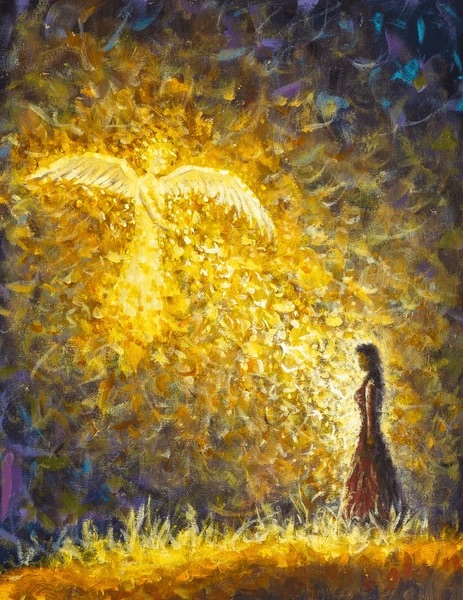
As Luke tells us the Christmas Story, he tells of wonder and amazement – from Mary’s “how can this be” to Gabriel’s “nothing is impossible with God.” God chose to come among us through the simple life of a young girl in a world dominated by older men. God chose to come to this world in a way quite discordant with what most expected, not with military or political or economical power, but with a simple family in a nowhere town. In two thousand years, our idea of how God should do things hasn’t changed much. Our world still tries to claim political, economical, and military power as God’s plan even as we look upon our manger scenes and read the stories that tell us differently*.
It is very unlikely that Mary could read or write but she was far from illiterate. She was a young woman well versed in and deeply shaped by her faith in God and she her perplexity at Gabriel’s visit enable her to marvel at God’s love and ask what was happening and why, not out of fear but in awe and wonder – that God would chose to come into this world, nurtured by a mother’s love. Raised by parents who chose to walk in the love they knew would be necessary for the calling they said ‘yes’ to. How often do we stop and let ourselves be amazed at the Love come to us.
I used to talk of unconditional love but I read somewhere recently that unconditional love is redundant because once you add a condition to it, it’s no longer love. Our presiding bishop Michael Curry defines love as ‘other focused’ and says the opposite isn’t hate but self-centeredness. St. Paul says “Love is patient, love is kind, it isn’t jealous, it doesn’t brag, it isn’t arrogant, it isn’t rude, it doesn’t seek its own advantage, it isn’t irritable, it doesn’t keep a record of complaints, it isn’t happy with injustice, but it is happy with the truth.”
(1 Corinthians 13:4-6 CEB). We can do all the good works in the world but if we are doing it for the purpose of making ourselves feel good rather than for the greater good of all, we are not acting out of love.
Yet, we can’t not mention that love as God loves, doesn’t mean we get away with harmful or dangerous behavior. Love isn’t a free-for-all, do-as-we-like-regardless-of-the-impact-on-others way of living. Love always considers the impact of our thoughts, words, and deeds on others, and to ask if what we may tell ourselves is love is actually self-serving rather than other-focused. Love enables us to speak up for those whose voice is not being heard, for those who are not being seen or considered, for those who are being harmed by another’s behavior. To love as God loves does mean we forgive and forgive and forgive, but it doesn’t mean anyone is free from the consequences of chosen behaviors. God’s Love may be boundless but it isn’t without boundaries.
Love enables us to govern our own behaviors by the light of God’s Love for us. We cannot control or change others motivations for their behavior but we can do the internal work of assessing our own motivations so that we can make loving choices about our outward behaviors.
None of us love perfectly as God loves – we are human and not God and God is more aware of our humanness that we are. And, yet, God chooses us, God’s created, God’s children, God’s beloved. In the now-and-not-yet of this world, we do our best with God’s help to love as God loves, in the hope of the Day of the Lord when God’s peace will be ours as we discover the real joy of God’s presence among us.
Mary asks “how can this be” and Gabriel responds “Nothing is impossible with God”. God is love and love is the most powerful force in the universe because God created all in and through and for love. Mary knows the depths of God’s love and accepts the sure and certain hope that Gabriel offers her. Her answer isn’t one of fear or resignation, her ‘let it be’ is a joyful proclamation that she wants to be a part of God’s work of love. She doesn’t fret about how she could get it wrong in so many ways, she trusts that with God nothing is impossible, even with our own human foibles. It brings much peace into my life knowing that when God ponders my work in this world, God knows all of the ways I can mess things up and still wants me to be a part of bringing about the kingdom on earth as in heaven. And he sees and wants each of you to be a part of it as well.
How can this be? Do you hear the wonder and amazement of Mary’s question? How can this be – that God wants to work in me? Do we ask the same wondrous question of our lives? Do we ask how God wants to work in our lives? Are we open to wonder and amazement at what God chooses to do in us and others?
We end our annual Advent season with the ongoing anticipation of the coming of God’s Kingdom on earth as in heaven. God comes to each of us, asking if we will be a part of God’s plan, today, tomorrow, and each day in the year to come. Let yourself be amazed. Let yourself wonder at who God is and Whose we are. Let the hope, peace, and joy of God’s love shine with all that you think, say, and do. Nothing is impossible with God. Let it be. Amen.
*https://www.saltproject.org/progressive-christian-blog/advent-week-four-lectionary-commentary
 Mother Nancy's Coffee Thoughts