A Sunday reflection on the lectionary readings for the thirteenth Sunday after Pentecost.
Jesus is sounding a bit harsh in our reading today, y’all. He can’t really be telling us to hate our families, can he?
No, I don’t think he’s saying that at all, it just doesn’t jive with the God of Love but when the words of Jesus as recorded by the writers of our scriptures make us say WHAAAT? it’s intentional. We are supposed to stop and really pay attention to the questions in our heads and hearts. Then we prayerfully consider what has Jesus said just before and after this? What’s the context in which he’s saying and doing? Who’s he talking to? Who’s he talking about? We have to be willing to acknowledge our own undiscovered biases that prevent us from seeing and hearing the Kingdom of God-on-earth-as-in-heaven.
Jesus is not saying that families don’t matter. He’s saying that our understanding of family needs to be grounded in God’s Kingdom not our own. The label ‘family’ doesn’t make us a family, how we love each other does. A particular last name doesn’t make us family, seeing each other as God’s beloved children does. Jesus is expanding and deepening our understanding of family so that it isn’t some artificial loyalty based on human ideas but healthy relationships nourished by love as God loves us. When Jesus says ‘hate’ here, he’s using hyperbole to help us look deeply at what we call ‘family love’ and assess it with God’s Love. Are we demanding loyalty regardless of behavior or are we loving as Jesus shows us in flesh and blood how to love. Do we live in a way that makes family loyalty more important that our faithfulness to the Good News of God in Jesus?
Jesus is speaking of our orientation toward the Kingdom-on-earth-as-in-heaven and the core of our identity. I first posted the following list on social media a few years back and I have added to it and reposted it a few times.
- When we find our identity in our romantic relationships, when we lose those relationships we lose who we are.
- When we find our identity in our spouse, we are not honoring them (or who God made us to be) by offering our authentic selves to them but rather giving them a false selfie of who we think they want us to be.
- When we find our identity in our children, and they grow up and leave home (as they should), we are as empty inside as our nest.
- When we find our identity in our job, we become human “doers” rather than human beings. And a job loss or even retirement means a loss of identity.
- When we find our identity in the things we own or how much money we have, we are seeking fleeting pleasure rather than everlasting life.
- When we find our identity in our social status or political party, we begin to rewrite the Gospel to define how we want the world to be so we can maintain our standing in it instead of letting the Good News of God’s Love shape us.
- When we find our identity in the power we hold over others, we’ve completely lost the Jesus-plot and are no longer following him.
When we find our identity in God, The One who created us in the divine image of love and community, who we are is eternal. We are who we are created to be, able to offer our real selves to others and to see them for who they truly are. In God, our identity is lived out through all our relationships as we seek to see God in all people, striving to love them as God loves us.
All of these types of relationships are significant in our lives but they are not to be the foundation for who we are. We are not defined by others in our life nor should we let other’s definition of who they think we should be determine who we are. God made us good and holy as his beloved children. This is the core of our identity that can never be lost or destroyed, although sometimes we do forget.
Jesus’ invitation to follow him is an invitation to remember who and Whose we are. It’s an invitation to live in the Kingdom-on-earth-as-in-heaven here and now. In our reading from the book of Deuteronomy, Moses tells the people of Isreal that God has offered them the choice of life and goodness or death and evil. The word we translate into English as life isn’t an individual word, it is used to mean relatives or community. God did not make us to navigate this complex world individualistically. As images of the Triune God we are made in the image of the ultimate community, the perfection of communion.
When we live from the image of God within us, when this is the core of who and Whose we are, we are most fully human because we cannot help but see the image of God in others and work with God’s help to live for the greater good of all. This is how we are to experience family in God’s Kingdom-on-earth-as-in-heaven. This is the life and the good we are made of and for.
Life in God’s Kingdom is life lived in relationship with God, others, and ourselves. It isn’t self-centered to do the hard work of pealing back the layers of the false selves we create to maintain power over others or fit in or people-please or survive difficult or abusive relationships. To go deep within ourselves to find the light of the image of God within is the Jesus-centered work of discovering who and Whose we are so that we thrive in our relationships with others, accepting the responsibility for our own behaviors, thoughts, and emotions and letting others be responsible for theirs. In community with each other as we all do our best with God’s help to follow Jesus here and now, we are family. We have chosen life and goodness. We have chosen to be fully human. We are the Kingdom of God.
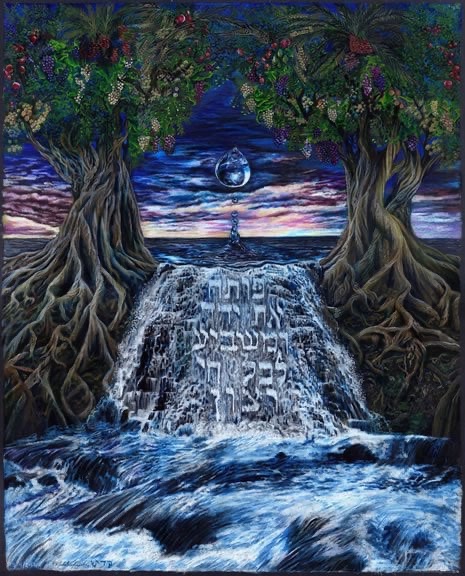
NOTE: The image is by Natalia Kadish. Here’s her explanation of her piece:
Artist’s statement: Each of the seven species of fruit represents a different kind of Jewish person. We should all be growing on one tree together in harmony.
The water represents how Hashem feeds us spiritually as well as physically. Torah and spirituality are likened to water.
 Mother Nancy's Coffee Thoughts