A sermon preached at St. Francis by the Lake Episcopal Church, Canyon Lake, TX.
The Lectionary readings for Palm Sunday are here.
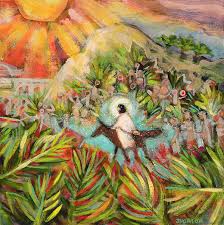
Palm Sunday is like a movie trailer for Holy Week: In just a few short minutes we go from shouting ‘Hosannah, Jesus is King’ to ‘Crucify Him!’ And we come to the abrupt end of Jesus’ death, a cliff-hanger to bring you back next week for Easter. If you only come today and next Sunday, you will see the story, but knowing a story and living the story are different.
I know it’s a challenge to be here through Holy Week, and it’s not just about making the time to come to church every day in our very busy lives. It’s also mentally and emotionally challenging. We remember the suffering of Jesus through these days and it hurts on so many levels. I get it. With hearts shaped by God’s love, we hurt to watch others hurt, we hurt watching someone cause harm to another. And knowing that God, blameless and absolute goodness, is suffering for all of our sin, our own choosing to go against what God has offered us, it makes the emotional toll even greater.
But no matter how much we want to distance ourselves from the violence perpetuated against Jesus and hop like a bunny from the Hosannahs of Palm Sunday to the Alleluias of Easter, we must remember that we can’t have the joy of the resurrection without first encountering the death that made the resurrection possible. Walking through the horrific events of the coming days hurts. And it heals.
It heals because it is how God loves. Knowing what he would endure, knowing his friends would betray him, deny him, knowing he would be beaten and abused and killed, Jesus showed up because that’s how God loves. Not to indebt us, not to require us to earn it or pay it back but because love shows up.
What we remember through Holy Week is about those who had been following Jesus AND also the people perpetuating the violence against him. In some cases, both of these were true with the same individual, cue Judas and Peter.
Just as God loves us as we show up to sing hosannah, God loves us when we shout crucify him.
God loves us when we are singing hymns and praying prayers and helping our neighbor AND God loves us when we label our neighbor in dehumanizing ways so we can justify wanting less for them than we want for ourselves. So if God loves us either way, why bother trying so hard to be like Jesus? I mean, he is God, so of course he could be that good. If he’s our standard, there’s not a lot of hope for the rest of us, right? It’s hard work to love those we don’t like, to give of ourselves so others can have what we have. It doesn’t always feel fair. What about when they don’t deserve it or haven’t worked as hard as me? Why should I care if they don’t have what they need?
The answer to why bother if it’s next to impossible lies within the question. We are created by God, in the image of God, with the ability to continuously become more like God living as Jesus shows in in flesh and blood. To be like Jesus we must follow Jesus. As we follow him we grow into the true self we are to be: each with our own unique skills and talents partnering with God and woven together as one community of people to show the world the gift of God’s love so others can begin becoming their true selves as well.
When Jesus says he has come to set us free, this is what he means – to free us from the myth that we can be our true selves apart from God. The resentment and anger we harbor when we make life about deserving and earning, does damage to our souls. Jesus invites us to let that go, just as the man on the cross who, even in the midst of his own terrifying death, had the courage to recognize his own failings and was free to be with God.
God does the work of reconciliation so that God can offer us the gift of relationship. We receive the gift and then live life worthy of all that Jesus endured for us. We accept how God chooses to save even when it doesn’t fit our idea of how we want to be saved.
When the crowds shout Hosanna (which means ‘save us we pray’) as Jesus is arriving in Jerusalem, they are crying out for God’s Messiah to come and fulfill God’s promises to save them from the destructive powers of this world. Many of them imagined a giant military force to squash the Roman Empire. God said that self-giving love is the Way to freedom.
Come Easter morning as we shout Alleluia (which means ‘praise the Lord’), we sing praises to the God who has saved us through Jesus’ life, death, and resurrection, the way of reconciliation with God our creator.
What God gives is pure gift – we don’t earn or deserve it; there is nothing we can do to save ourselves; it isn’t a competition of who God loves more. You hear me say it all the time – there is absolutely nothing any one of us can do to make God love us any more or any less than God loves us.
It’s quite challenging to think of the horrific events of Jesus betrayal and arrest, mock trial and murder as gifts from God. It’s far easier to think of God’s gifts at Christmas – a cute little baby wrapped in a blanket with people coming from all over to see him and coo. But the baby came so that we could have the gift of Easter – God giving God’s life for ours to set us free from the idea that we can save ourselves, that we can decide better than God what is good or what is bad, that we can self-design a relationship with God to suit our own comfort zone.
God gives gifts freely and we must receive them. Gifts are only complete when they are also accepted. God’s forgiveness is guaranteed but not automatic – we have to admit we’ve done something that needs forgiving. If we don’t think we’ve done anything wrong, what do we need to be forgiven for? Why would we even reach out to receive the gift? We all at one point or another behave in ways that go against God’s Love. It is part of being human. And so is the goodness and love with which we are created. We receive the gift of forgiveness not so we can prove how wretched we are but so that we can live the life we are made to live: a life grounded by loving God and loving our neighbor as ourselves.
I invite you to come for the whole experience this week. Go deeper than just knowing the story. Let the story we tell this week shape who you are continuously becoming and how you live every day that follows. Let the story of Jesus’ life, death, and resurrection free you to be who you are meant to be, God’s beloved. And together we can show the world the abundance of God’s love. Amen.
 Mother Nancy's Coffee Thoughts