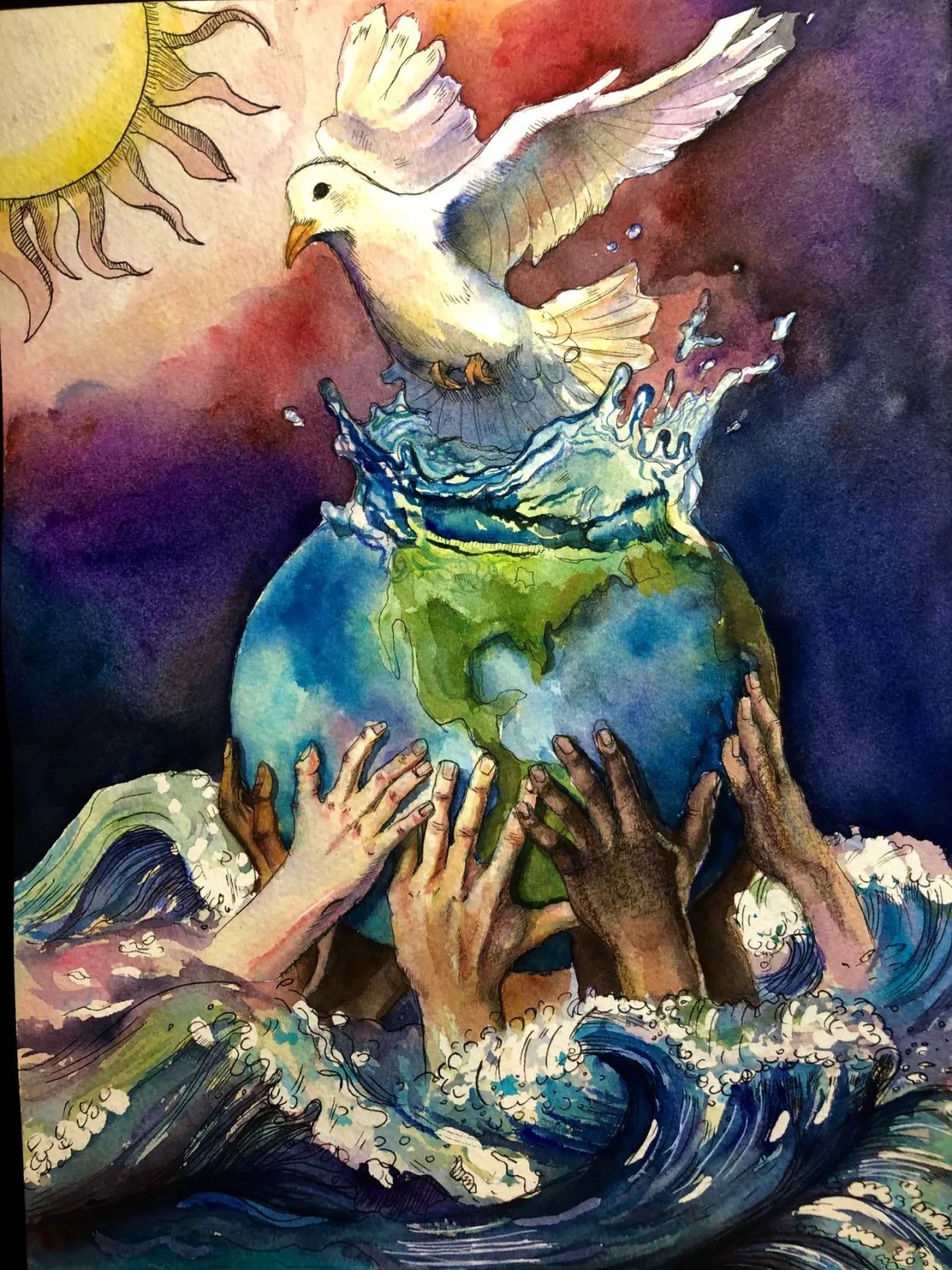
A sermon preached at St. Francis by the Lake Episcopal Church, Canyon Lake, Texas.
The lectionary readings for the Second Sunday of Advent are here.
Don’t you just love this time of year when you can yell “don’t come in here” and folks just think you are wrapping presents instead of avoiding people and trying to find a little peace amidst the chaos.
Today, on this second Sunday of Advent, the theme is Peace, the peace that can only come from the sure and certain hope (last week’s theme) we have in God’s faithfulness. So much of the time I think we simplify the meaning of peace to be the absence of conflict or stress, or walking through life without any bumps or potholes in our path. But that’s just not realistic is it? Life always has bumps and potholes and sometimes raging rapids to mix to mix my metaphors well.
It’s easy to say we want peace, but peace is something we must work toward. Jesus calls us to be peace makers not peace keepers. The Romans ‘kept’ the peace in first century Palestine by making everyone afraid.
So, when we say ‘the peace of God’ just what do we mean? The Hebrew word ‘shalom,’ which we translate into English as peace, is best understood as wholeness. And the Greek word for peace is related to the verb ‘to join’ so that peace is found in being joined together. In Christ, we are made whole and are joined together as God’s beloved children, the body of Christ. God created us for relationship – with God, with each other, with the world and all of creation – and through us, God has chosen to begin healing the world with the power of love. The peace of God’s Kingdom on earth as in heaven is an active peace.
When we pass the peace, we are doing so much more than saying hi. We are, quite literally, offering each other the Peace of God, wholeness, being joined together. With the simple phrase “the peace of the Lord” we claim our confidence in God’s love and forgiveness that make us worthy to come to God’s table, at peace with God. And we are saying from our hearts “if I’ve done anything that has hurt you that I’m unaware of, please forgive me so that we can go to God’s table at peace with each other.” It is saying that in the midst of the chaos in this world, we trust in God’s faithfulness so that we can be at peace in God’s Kingdom on earth.
This is just a taste of the peace we are to work toward in the world, the work of bringing people together instead of dividing us from them. The work of peace makes bigger tables not fences or walls. The work of peace works to dismantle the political and societal systems that elevate one group above another. The work of peace works toward justice for all of God’s beloved children, building up, not dividing or tearing down.
In place of our psalm today, we read Zechariah’s prophecy from Luke’s telling of the Good News. Zechariah was John the Baptizer’s father. And when the angel Gabriel came to him to announce that Elizabeth would give birth to the Messenger who will prepare the way of the Lord, Zechariah was given the gift of silence, he was unable to speak through Elizabeth’s pregnancy. And the first words Zechariah said in months were about peace, the peace that can come only from God’s righteousness and justice.
Elizabeth and Zechariah’s son, John, was to prepare the way for the Messiah, the One whose light will guide our feet into the way of peace. When we follow Jesus, we work for the peace of God’s kingdom, with our work, our words, our wisdom, and our wealth.
John the Baptizer was the last of the Old Testament prophets, proclaiming the message of God’s faithfulness in announcing the coming of God’s Messiah. In our prayer today, we ask for God’s grace that we might truly hear the words of God’s prophets that call us to repent so that we are prepared to receive God’s salvation.
We’ve talked about repentance before but I think it’s going to take a lot more church conversations to undo the years and decades of our misunderstanding illustrated by the street corners and TV preachers who yell ‘repent’ in angry voices to scare us into submission. If anyone is trying to preach the good news with fear, it isn’t good and it isn’t about God. So, who remembers what repent means: To change our hearts and minds, to reorient ourselves toward the Kingdom on earth as in heaven, literally to turn around. Repentance isn’t about beating ourselves up or shaming or belittling or condemning ourselves or anyone. Repentance is the realization that our way hasn’t brought about much love and reconciliation in this world and that God’s way does. We turn and ask for God’s forgiveness and we do life differently, following Jesus in the way of love that brings Peace on earth and goodwill to all.
If we are moving through life constantly angry or with contempt for others we will never know true peace and so we have to change how we move through this world. If we want things to change, we have to turn our hearts and minds toward God’s Way and ask God to forgive us and let the Spirit transform us, heart, mind, body, and soul.
God’s forgiveness is transforming, it releases us, frees us from the enslavement of our sin, our desire to put ourselves first, to raise ourselves up above others. The words Malachi uses to describe the coming Messiah aren’t about punishment or condemnation but about purifying, making holy, cleansing and freeing from sin. A refiner purifies metal and a fuller cleans and beautifies the cloth; they don’t destroy rather they make the metal or the cloth what it is supposed to be. God’s forgiveness isn’t to bring us fear but peace, the wisdom that only with God can we become who we are created to be. We are refined by the ongoing, lifelong journey with Jesus.
The peace of God’s kingdom on earth comes with relationship, our relationship with God, with each other and all of God’s creation. And although there are times we all need a quiet space to be with ourselves we can only be at peace alone when our relationships are in good order. And tending to our relationships takes work. This is the peace making Jesus talks about: Blessed are the peacemakers for they are called the children of God.
So, instead of trying to escape the chaos of this world or artificially keeping peace by pretending we have no challenges along the Way. , find Peace in our relationship with God, the peace that comes from surrendering our will to God’s and together let’s do the work of peace-making in our relationships with each other, the world, and all of God’s creation.
I’d like to end with a poem by Malcolm Guite, an Anglican priest and poet, and I invite you to close your eyes and listen with your heart. It is titled simply “peace”
Peace by Malcolm Guite
Not as the world gives, not the victor’s peace,
Not to be fought for, hard-won, or achieved,
Just grace and mercy, gratefully received:
An undeserved and unforeseen release,
As the cold chains of memory and wrath
Fall from our hearts before we are aware,
Their rusty locks all picked by patient prayer,
Till closed doors open, and we see a path
Descending from a source we cannot see;
A path that must be taken, hand in hand,
Only by those, forgiving and forgiven,
Who see their saviour in their enemy.
So reach for me, we’ll cross our broken land,
And make each other bridges back to Heaven.
Amen.
 Mother Nancy's Coffee Thoughts