A sermon preached at St. Francis by the Lake Episcopal Church in Canyon Lake, Texas.
The lectionary readings for Easter Sunday are here.
Alleluia! Christ is Risen!
Easter is the most Important Holy day, holiday, of our Christian faith; it is the foundation of all that we believe and proclaim with our worship and the way we live our lives as Jesus followers – as Resurrection People, living on earth as in heaven, participating with God in bringing hope and peace to the hurting world we live in. Easter is also the basis for the most prominent symbol of our faith: the empty cross – the instrument of death redeemed by God to be a symbol of hope and new life.
Do you know how some of what have become symbols of this holiday, such as eggs, come from? The egg is an ancient symbol of new life. Our Christian association of eggs with Jesus’ resurrection on Easter is a backward looking association connecting two historically unrelated things. There are legends that say Mary Magdalene either had a basket of eggs with her at the tomb on the first Easter morning or after the ascension gave one to the Emperor to explain the resurrection. In each story the eggs miraculously turned blood red. The word “egg” only appears once or twice in scripture depending on the translation. Luke gives us the words of Jesus, “if you child asks for an egg, would you give her a scorpion?”
Decorating eggs for Easter is a tradition that only began about the 13th century and they were dyed red to symbolize Jesus’ blood. Eggs were a forbidden food during the Lenten season so people would paint and decorate eggs to mark the end of the period of fasting, then eat them on Easter to celebrate.
And did you know that the Bible makes no mention of a long-eared, fluffy-tailed creature who hops around and delivers decorated eggs to well-behaved children on Easter Sunday? Nope. No bunnies at all. Nevertheless, the Easter bunny has become a prominent symbol of Christianity’s most important holy-day. The exact origins of this magical mammal are unclear, but rabbits, known to be prolific procreators, are like eggs an ancient symbol of fertility and new life.
A bunny bringing eggs to good girls and boys seems to have begun with German Lutherans. The idea that the bunny actually laid the eggs first arrived in America in the 1700s with German immigrants who settled in Pennsylvania and brought their tradition of an egg-laying hare called “Osterhase” or “Oschter Haws.” Their children made nests in which this creature could lay its colored eggs.
Eventually, the custom spread across the U.S. and the rabbit’s Easter morning deliveries expanded to include chocolate and other types of candy and gifts, while decorated baskets replaced nests. Like leaving cookies and milk for Santa, Children often leave out carrots for the bunny in case he got hungry from all his hopping and that’s why we have carrots at Easter.
As for the chocolate, we can joyfully credit Cadbury’s, the first chocolate company to produce a chocolate Easter egg in 1873 and the first to figure out how to mass produce hollow chocolate bunnies so that they would be affordable to the masses.
The only other modern Easter symbol that is mentioned in scripture is the Lily. In the Sermon on the Mount, in telling us not to worry, Jesus says “consider the lilies of the field how they neither toil nor spin yet are more beautiful than any of Solomon’s robes.” The lily is a symbol for purity as well as new life and hope. Legends tell us that on the day of the resurrection, lilies sprang up wherever Jesus blood stained the ground, both in the garden of Gethsemane and on Golgotha.
I delight in the bunnies and eggs and flowers at Easter and I definitely have no problem with chocolate, except when there isn’t enough of it. Eggs, bunnies, and flowers are all things appropriately associated with life and new birth – the very gifts God gave us through the death and resurrection of Jesus. And through the past 2000+ years, people have, with the best of intentions, used these items to help others understand the power of the Jesus’ resurrection to change everything with the Good News: God took the very worst the world could do and offers us the very best: abundant life in the Kingdom.
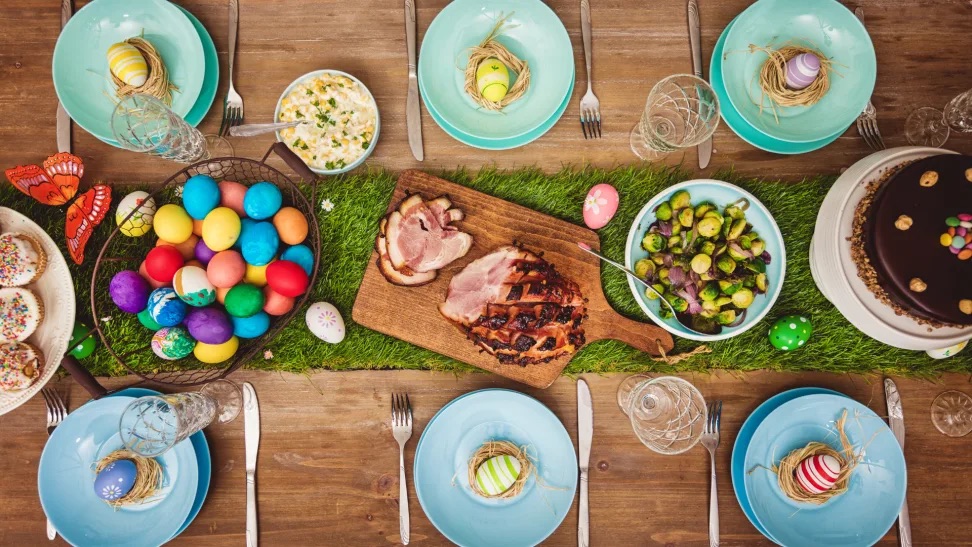
Many of us will have feasts today around bountiful tables with people we love. So much of Jesus’ ministry was feeding and tending to others with the invitation to come and see what life is like in God’s kingdom on earth, the abundance of love and peace and hope, with no one lost among the margins.
What if we made the tables and feasts our most prominent symbol of our faith? The Table that is at the climax of our weekly worship sometimes seems less visible that the symbols we use for the grand holy days, perhaps because it is what we do regularly. The Feast of God’s Table is what Jesus told his disciples to do to remember. What God did through Jesus’ death on a cross is so that we can feast at God’s Table and invite the whole world to join us.
Jesus came to proclaim the Kingdom of God, a kingdom built of relationships, bound together by the love of God flowing through us into the broken and hurting world that desperately needs to hear the message of life and love.
For Jesus and his followers in first century Palestine, the world was just as politicized and polarized as ours is today. The Jewish religious and Roman empire leaders who were against Jesus didn’t just disagree with what he taught. Their control of the population was based on fear and intimidation and Jesus’ message that we should all treat each other from a foundation of love threatened their power. The leaders wanted to completely and totally silence him and his followers and the best way to do that was in death.
This wasn’t just some horrific and unexpected turn of events. Jesus was never plan B. It was God’s plan all along to come and live among us, as one of us, to experience the pain and suffering of being human, and to reveal himself to the people of the world who had forgotten him as their creator. To show that not even mortal death was more powerful than God’s love.
What we celebrate on Easter is the gift of grace and hope and forgiveness that can only come from God. By what God has done, we are given the inheritance of God’s kingdom so that we can live aware of his presence now. By what God has done, we can trust that the God who created us in love, to be loved, and to love will someday reconcile all things and put things as he intends them to be.
When Jesus asked Mary ‘why are you weeping, whom are you looking for’ he was doing more than just speaking words of comfort. He is giving her the true meaning of life for every human being. All that we think we are looking for can be satisfied by the new life we are given in our relationship with God.
Easter isn’t just a one day a year celebration nor just a 50 day season in the church. Easter is the way of life for all who follow Jesus. Like Mary we are to follow Jesus into the hurting world to share the message of love, participating with God in building God’s kingdom on earth, making more and more room at the feasting table. And that’s better than anything you can fit in an easter basket. Alleluia! Christ is risen!
 Mother Nancy's Coffee Thoughts